What Exactly Is a Black Hole?
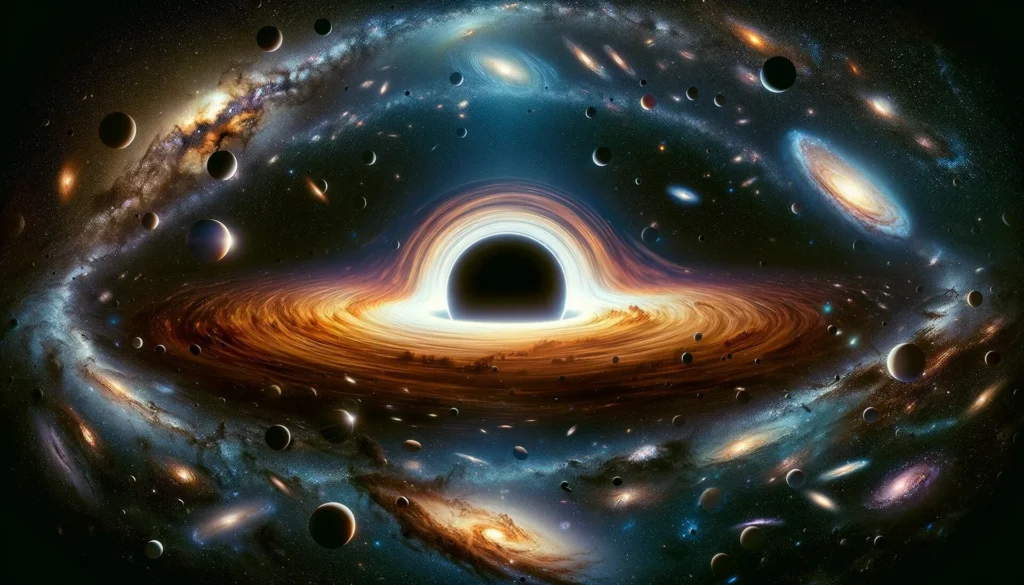
Before discussing what a collision with a black hole would mean for us, let's properly imagine the potential problem. First off, a black hole is not actually a hole. At least, not in the way we understand holes here on Earth.
No one knows for sure what its real shape is. A black hole is practically invisible in the dark cosmos, that is unless it happens to collide with a star.
In such cases, telescopes can capture the rays currently being absorbed. Though "currently" is a relative term in space.
The events we can observe with a telescope today might have happened during the times of the Egyptian pharaohs, or even much earlier. Our observations are entirely dependent on the speed of light and distance.
Not too long ago, black holes were just an unproven theory. Thanks to modern technologies and new methods applied in space observation, scientists can now quite safely locate black holes in the cosmos.
However, this is only under the assumption that they are affecting their surroundings.
Gateway to Other Worlds
Many enthusiasts and regular scientists believe that a black hole could also be a gateway to other dimensions. However, there is no tangible proof for this theory.
In reality, no one can know for sure what it looks like inside a black hole, if it looks like anything at all. It's understandably impossible to get close enough to a black hole, even if we had the right technology.
According to the general theory of relativity, the inside of a black hole represents a singularity where neither space nor time exists. Such a place is essentially unimaginable for humans, as our minds only know standard reality.
Spaghettified Earth
Although we can't see directly into the heart of a black hole, we can observe what happens in its vicinity. All objects that come close are mercilessly swallowed by the black hole. Its gravity is so brutal that it can consume stars many times larger than our Sun.
This tells us that the consumed objects stretch out similarly to cooked spaghetti. The same would undoubtedly happen to our planet. However, we need not fear being sucked in and elongated by a black hole.
If a black hole were to suddenly appear near Mars tomorrow, it would first strip the Earth of its atmosphere.
Then, due to tidal forces, the planet would start cracking, leading to massive magmatic eruptions, and only then would the stretching follow. By that time, humanity would, of course, no longer exist.
FAQ
What would happen to Earth if a black hole appeared near Mars?
It would first strip Earth of its atmosphere. Tidal forces would then crack the planet and trigger massive magmatic eruptions, and only after that would the stretching follow. By then humanity would no longer exist.
How far away is the nearest black hole?
The nearest known black hole is approximately 25,000 light-years away, so nothing of the sort is located near us.
How do scientists find black holes?
A black hole is practically invisible in the dark cosmos unless it collides with a star. Then telescopes can capture the rays being absorbed, and scientists can locate it, as long as it affects its surroundings.
Is a black hole a gateway to other dimensions?
There is no tangible proof of that. Some enthusiasts believe it, but nobody knows what the inside looks like. According to general relativity, it is a singularity where neither space nor time exists.
The Universe Is Full of Black Holes
Today, we know that the universe is full of black holes. If a larger one were to show up at our doorstep, we wouldn't stand the slightest chance of escaping. Fortunately, nothing of the sort is located near us.
The nearest black hole we know of is wreaking havoc far from us, approximately 25,000 light-years away.