
When There Are Too Few or Too Many Participants
The ideal situation is when the number of participants matches the program's capacity. In practice, though, an event sometimes has too few participants, or, on the contrary, significantly too many participants, and the program has to be adjusted accordingly.
What should you do when there are really a lot of participants and the company wants a specific program that isn't built for that many people? Is it better to adjust the size of the participant group, or to focus on adjusting the program?
You'll resolve a mismatch between program capacity and group size by first comparing the capacity of the chosen program with the number of registered participants. When planning an event for hundreds of people, we choose one of the following paths.
- We split the participant group into several parts, and each part does a different program.
- On the given date, we run the program for only part of the participants, and for the rest the program takes place on another date.
- We choose a different program that better suits a large group of participants.
When there are extremely few participants, on the other hand, there's usually only one way to go: choose a program that works even with a very small group without losing momentum.
Dozens, a Hundred or Hundreds
Count your registrations before choosing a program. Group size changes the whole structure of the event, not just the number of instructors, and three typical real-world situations show you where the tipping point lies.
A few dozen people fit into one story and one space. The instructor keeps track of every team and the program runs as a single whole.
At around a hundred participants, the event splits into parallel teams. Each team has its own instructor, stations run simultaneously and nobody waits in line.
With several hundred people, logistics decide: registration, moving between stations, sound for the joint kickoff, and a finale where the teams meet again. Before you book, check:
- a space for both the joint opening and the closing
- the number of instructors and parallel stations
- the schedule for transfers and meals
- a backup indoor program in case of bad weather
Development Programs
If you want to hold a program with a more developmental focus, inviting several hundred employees isn't a good idea, because development needs room for everyone.
Development programs require a special approach. The trainer needs to see individual people's reactions in order to work well with each participant, and that's impossible in a large crowd.
For development programs, we therefore recommend an event for a handful up to a few dozen employees. Usually it's one team or one department that works together on a regular basis.
Experience and Team Spirit
You'll definitely enjoy experience-based or team spirit programs with colleagues from across the company, and it's no problem to run them for several dozen up to hundreds of people.
Programs That Scale
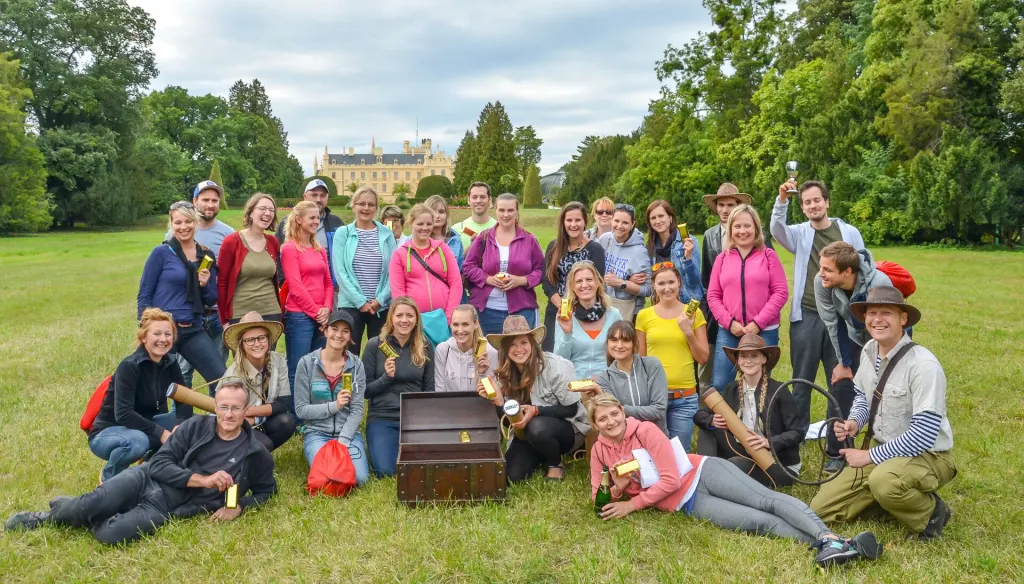
For hundreds of people, story-driven team-building activities work well: teams complete tasks in parallel and meet up at the end. Indiana and the Holy Grail is built on the Indiana Jones story and ends with a final collaboration between teams.
Sherlock Strikes Back draws the group into a detective story with instructors in constable costumes. Castle Breakout is played at a real castle, with costumes and medieval weapons.
These programs handle even large groups, because teams rotate between stations and the story holds them together. In your inquiry, state the exact number of participants and have us confirm the number of instructors and stations.
Virtual Corporate Events
Online programs offer the widest options; they can be run for groups from a handful of people up to thousands.
Besides a practically unlimited number of people, these programs aren't limited geographically either. Colleagues sitting on different continents can join the event at the same moment.
How the Number of Participants Affects the Price
The number of people has a major impact on an event. A corporate event for a larger group has the advantage that you can work better with the budget the company has set aside for it.
The event's fixed costs are spread across many participants, so the cost of delivery per person comes out more favorable than for a small group.
Planning a Corporate Event
Before you start choosing a program, write down the purpose of the event in one sentence. It makes a difference whether employees are mainly meant to have fun, or whether the event should also have educational potential.
With a large group, everything else depends on it. A reward for a good year can handle a more passive experience program; a development goal needs smaller teams.
A Corporate Experience with Adrenaline
Adrenaline is tempting, but with hundreds of people it takes more thought than with one team. Arrange a safety briefing in advance with the professionals running the activity, and follow their instructions without exception.
With flying activities, the weather decides, and if the forecast is bad, it's better not to insist on going ahead.
A Gourmet Experience
Not everyone enjoys heights or speed. Wine tastings, chocolate tastings, making your own pralines or a cooking workshop appeal even to those who don't seek out adrenaline.
They have one practical advantage: they can be held all year round, regardless of the season and the weather.
FAQ
Which team building should a company with a hundred or more employees choose?
Large groups suit story-driven and experience programs where teams complete tasks in parallel and meet up at the end, such as Indiana and the Holy Grail or Sherlock Strikes Back. A development program makes no sense for a group that large.
What should you do when the team-building program you chose doesn't have the capacity for the whole company?
You can split the group into several parts with different programs, run the program for some of the people and offer it to the rest on another date, or choose a program better suited to a large group.
Why isn't development team building done for hundreds of people at once?
The trainer needs to work with each participant, and that's impossible in a large crowd. Development programs therefore belong to one team or department, meaning a handful up to a few dozen people.
Does a corporate event for a large group cost less per person?
Yes, the event's fixed costs are spread across more participants, so the cost of delivery per person comes out more favorable than for a small group.
What if it rains during team building for a large group?
A backup indoor program is prepared in case of bad weather. Gourmet experiences such as tastings or a cooking workshop don't depend on the weather at all.